Why Is My Candle Tunnelling?
You light your new perfumed candle, come back after thirty minutes, and find a neat hole burned down the middle with a hard ring of wax stuck to the sides. It's the most common problem in candles, and it doesn't discriminate by price. Expensive ones tunnel as readily as supermarket ones, and no candle is immune. It comes down to how it was made and how it's being burned. The short answer is that the candle isn't producing enough heat to melt the wax all the way out to the edge.
The longer answer is the useful one, because tunnelling rarely comes down to one fault. It's usually some combination of the wick, the wax, the width of the vessel and, most often, what happened the very first time it was lit.
It's worth understanding, because a tunnelled candle isn't just an eyesore. You lose a third or more of the wax you paid for, and the scent throw falls away with it. A candle that can't hold a full melt pool can't put much fragrance into the room either.


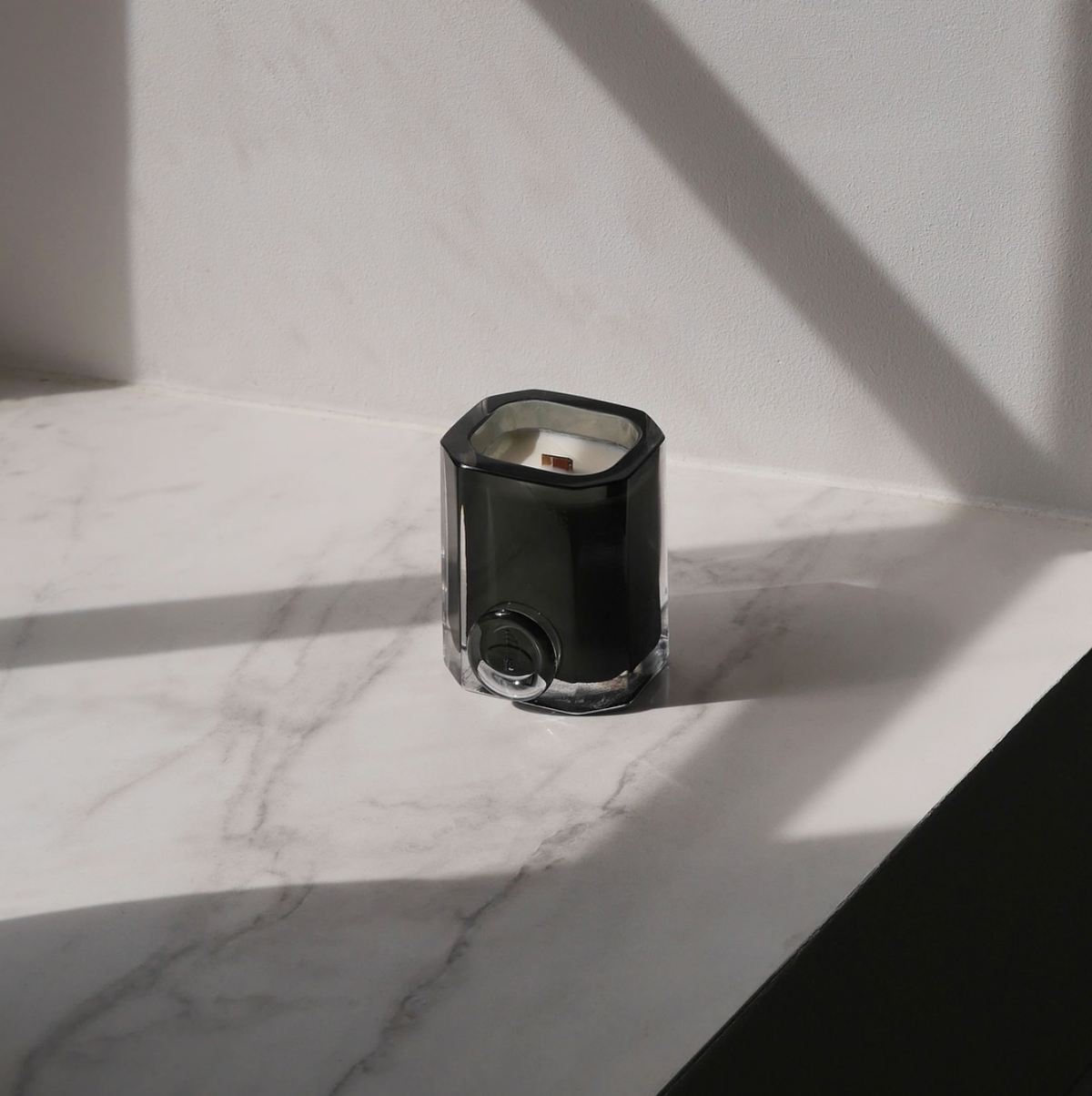
We used the same candle (i.e., before and after), for illustrative purposes only, letting it tunnel and then fixing it with foil over the rim (see instructions below).
What is wax memory?
The single most useful thing to know about burning a candle, especially when burning a new candle for the first time.
As a candle burns, wax melts outward from the wick until the pool reaches a stable width and stops. Blow it out and that pool sets. Next time, the wax melts back to roughly the same width before it starts pushing outward again. In other words, a short first burn sets a ceiling for every burn afterwards.
Light a new candle for twenty minutes while you're cooking, and you've told it how wide to melt for the rest of its life. I've seen this ruin genuinely well-made candles, which is the frustrating part.
How long should the first burn be?
Until the melt pool reaches the edge of the vessel. That's the only answer that matters. The clock is just a way of estimating it.
The rule of thumb in the trade is roughly an hour per inch of vessel diameter, which for most candles means two to three hours. Use that as a starting point and then look at the candle rather than the timer. If the pool has reached the edge in ninety minutes, you're done. If it hasn't after three hours, put it out anyway, because burning on past that overheats the vessel and does more harm than good.
After the first burn, two to three hours is plenty. Longer isn't better, and I'd rather you got three good evenings a week out of a candle than one very long one.
I did burn it properly. Why is it still tunnelling?
Several possible reasons, and one of them isn't your fault at all.
| What is happening | What you'll see | What to do |
| Short first burn | A narrow pool from the start that never widens | Easily the most common cause. Rescue methods below |
| Repeated short burns | The pool gets narrower over time | Two hours minimum, or don't bother lighting it |
| A draught / moving air | Flame leaning, melt higher on one side | Move it away from doors, windows and radiators |
|
Wick drifting off-centre |
Pool forming to one side | Nudge it back with a wick dipper or a matchstick while the wax is soft |
| Dense or hard wax | Slow melt, tight pool | Longer first burn. Some waxes simply need more time |
| Wick too small for vessel | Never reaches the edge, however long you burn it | This is a manufacturing fault, not a user error |
That last row (i.e., 'Wick too small for vessel') deserves more than a table cell. It is critical that wick size is matched to the diameter of the vessel and to the specific wax, and getting it right takes proper testing; burn after burn, adjusting one variable at a time. It's tedious, and a lot of brands don't do enough of it.
If a candle won't form a full pool after three hours, no technique on earth will fix it. It was built wrong. That's worth knowing before you start blaming yourself, and worth raising with whoever sold it to you.
Can a tunnelled candle be saved?
Usually, if the tunnel hasn't gone too deep. Three methods, easiest first:
Foil: Wrap kitchen foil round the top of the vessel and fold it inward over the rim, leaving a hole above the flame. This traps heat over the hard ring and softens it. Burn for an hour or so, then take the foil off carefully (it may be hot to touch), and pour off any excess liquid wax if the pool has become too deep. Repeat if you need to. It looks daft but it works!

Hairdryer / Heat Gun: On a low setting, warm the hardened wax until the surface softens and levels itself out. Let it set completely before relighting. Quicker than foil, and better for a shallow ring.

Keep what you take out. Put it in a wax warmer and you get the scent from it anyway, without the flame. Wax that never made it into the melt pool is perfectly good wax, and there is no reason for it to end up in a bin.

When it isn't worth the bother: If the wick has drowned in wax, or the tunnel has gone more than about halfway down, stop. You can spend an entire evening on it and still not get a full pool back. Take out what's left, keep it for a warmer, and clean the vessel.
Whether the vessel is then worth keeping depends on who designed it, how it was designed and whether it is refillable. Most candles are sold in a thin jar that was only ever meant to hold wax, and once the wax is out the jar (in most cases) ceases to serve a purpose and so ends up in landfill.
A vessel designed as an object in its own right, is a different case. It will hold rustic stems, jewellery, or nothing at all, and it can sit on a shelf as a decorative piece, rather than being discarded.

Does trimming the wick help?
For tunnelling, only indirectly. Trimming is mostly about soot.
An untrimmed wick burns with a bigger, less stable flame, which means more soot, more smoke and black marks creeping up your walls. Spend any time on candle forums and you'll find people who have had to repaint a room after a winter of burning candles hard and never trimming them. It's a common enough complaint, and an expensive way to learn the lesson. Trim to about 5mm before every burn, or nearer 3mm for a wood wick.
What trimming does do for tunnelling is keep the flame steady and centred, which helps the pool spread evenly. Worth doing. Just not the fix on its own.
Are some vessels worse for it than others?
Yes. Wide vessels are harder work than narrow ones, simply because the melt pool has further to travel before it reaches the edge. Straight-sided vessels are more forgiving than tapered ones. And a heavy-walled vessel holds heat, which helps the pool spread. That's one of the few genuine advantages of thick walls over thin.
Material matters less than people assume. What matters is the diameter, and the wick somebody chose for it.
What we do about it
Tunnelling is a wicking problem before it is anything else, so that is where the testing goes. Every wick is burned against the specific wax and the specific vessel, one variable at a time, until the pool reaches the edge. It is slow work and it is the reason I can write about this at all.
Our glass vessels are blown by hand, so the internal volume varies a little from one to the next. That variation is exactly why every refill is made to a single size that fits them all. We use wood wicks, which want trimming to about 3mm rather than 5mm, and which drift off-centre less than cotton does.
We provide full burning guidance on every product page and on our dedicated Candle Etiquette & CLP page. However, if one of our perfumed candles won't form a full pool after two hours, drop us an email at hello@enyalye.com and we'll do everything to correct our mistake.
We’re not afraid to admit when we’re the problem.
Our vessels are made to be kept in any case. Glass blown in Wiltshire, porcelain cast in London, both designed as objects before they were designed to hold anything. A refill drops in when you want one. When you don't, the vessel holds stems, or sits empty on a shelf, and it earns its place either way.
Common questions
How long should I burn a candle after the first time? Two to three hours. Past that the vessel overheats, the wax degrades, and you get more soot for no extra scent.
Can I stop tunnelling once it's started? Often, yes. Foil, a hairdryer, or scraping the ring level. Deep tunnels where the wick has drowned usually aren't worth rescuing.
Is tunnelling dangerous? Not in itself, but a deep tunnel concentrates heat at the base and can crack glass. Stop burning once it's gone past halfway down.
Should I let a candle burn all the way to the bottom? Stop with about 10mm of wax left. Below that the flame sits too close to the base and overheats the vessel.

Written by Akbar Iqbal