Article: Refillable vs. regular candles
Refillable vs. regular candles
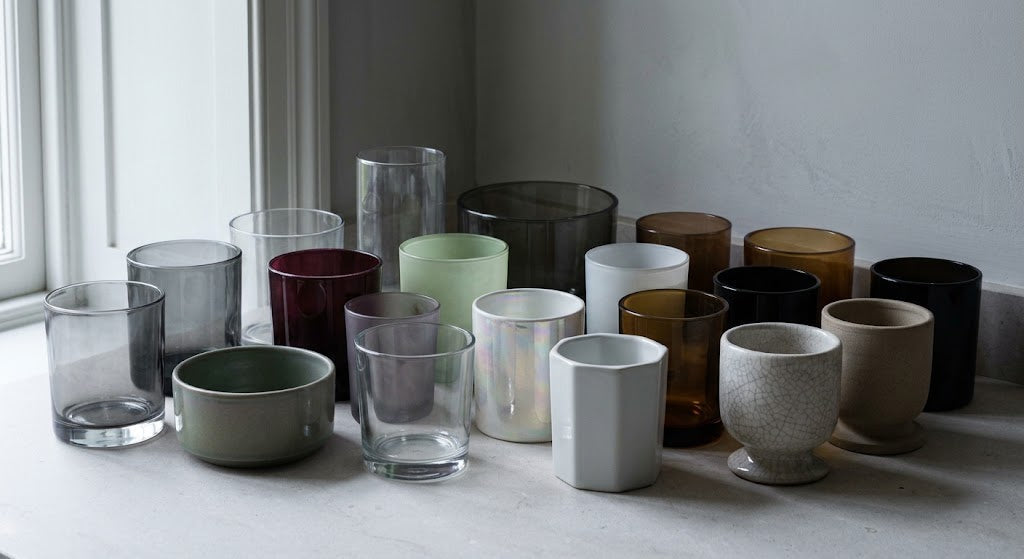
Think of every scented candle you've burned over the past few years, and imagine you'd kept all the empty jars. Not just the two you found a use for.
Nobody does keep them, of course. You hold on to a few, one holds pens, one goes to a friend, and then one evening you decide enough is enough and the rest go in the bin. It rarely feels good. The glass is perfectly sound and you know it.
That small hesitation before you let go of them is worth paying attention to, because it is not a failure of willpower. It is the object telling on itself; almost every candle jar was designed to eventually be thrown away and replaced.
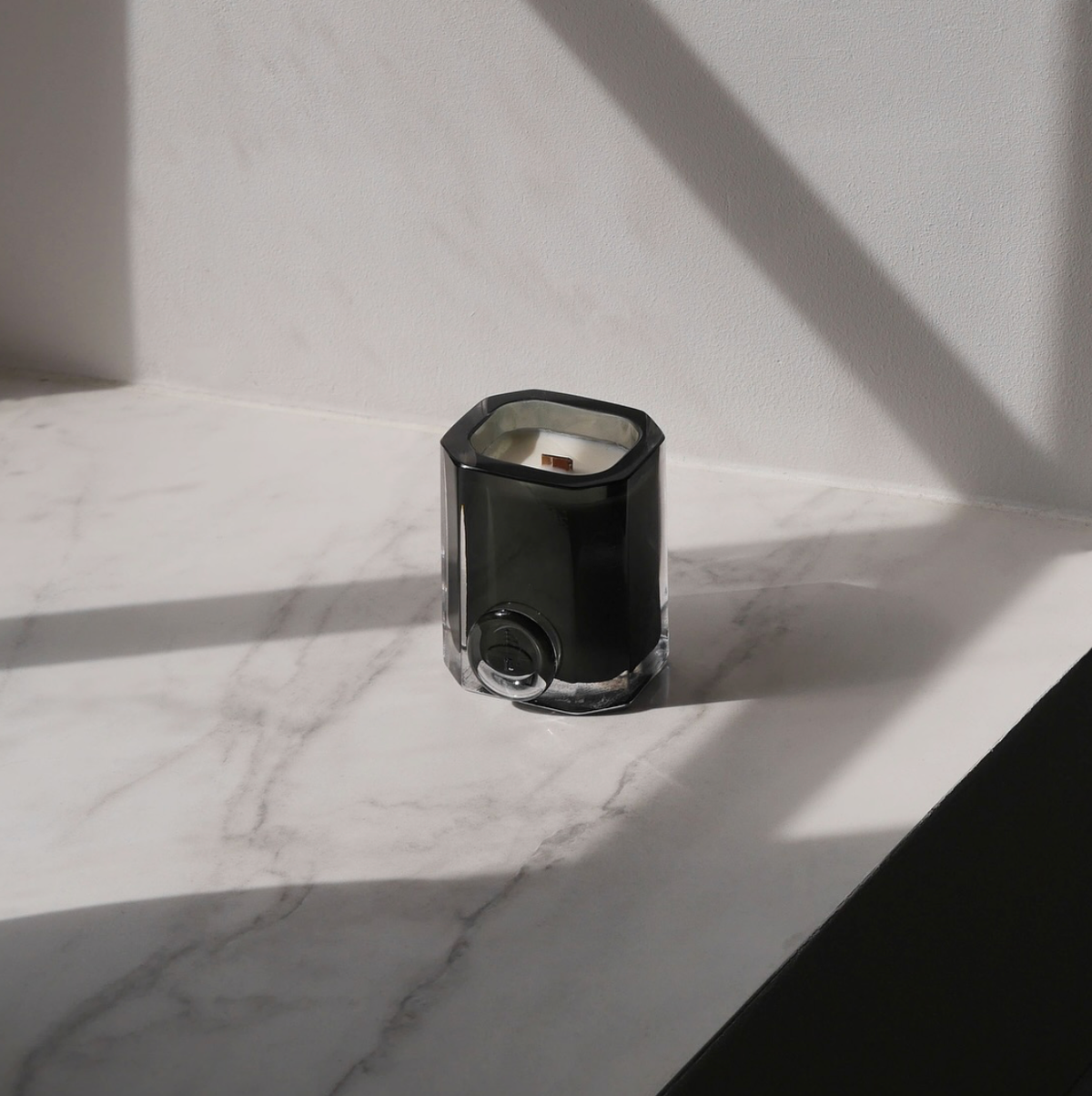
We are a British design house making perfumed candle vessels and interior objects by hand, working with independent makers across the country, from glassblowers in Wiltshire to ceramic studios in London. We started because of that hesitation, and because we thought it could be designed out.
Are refillable candles actually better for the environment?
Only if the vessel is one you genuinely want to keep. Refilling is a mechanism, and on its own it changes very little; a container nobody loves ends up in the same bin as a disposable one, a few months later. Whether a refillable candle is better comes down to design rather than to materials or schemes.
That is not how the industry usually frames it. Sustainability in consumer goods is nearly always treated as a function. Make it refillable, recyclable, compostable, and the job is considered done. Function is easy to add and easy to advertise. It also tends to arrive with a quiet caveat; the thing is built to survive a set number of uses, after which you are expected to buy another one.
We think design comes first, and that almost everybody skips it.
An object that is genuinely well designed does not need a scheme to rescue it. It gets kept. It gets passed to someone. It gets sold on, and whoever buys it keeps it too. The reason antique furniture is not an environmental problem is not that anyone engineered it for circularity. It is that it was made well enough that nobody has ever wanted to throw it away.
Function gives you an object you are supposed to keep. Design gives you one you want to keep. Only the second survives a real home and a full cupboard.
So we designed the vessel before deciding what would go inside it, and we did it with designers drawn from several disciplines. The brief was not a nice candle jar. It was an object that would still be wanted when it was empty.

Most of the cost is paid before you light it
This is the part that changed how we think, and it is not widely understood.
Glass is melted at well over a thousand degrees. The great majority of a glass object's carbon footprint is spent in the furnace, long before it is filled, boxed or sold. By the time a candle reaches your living room table, nearly all of the environmental cost of that vessel has already been incurred. Burning the wax adds very little on top.
Which means the only thing still within anyone's control is how long the object stays in use.
A vessel used once has spent its entire carbon budget on a single purpose. The same vessel kept for thirty years has spread that cost across a lifetime of evenings. Nothing else in the equation moves. Not the wax, not the packaging, not the recycling bin.
It is a useful thing to carry into any shop, not only ours. The question is rarely what a thing is made of. It is how long you will want it.
What is the difference between a refillable candle and a regular one?
A regular candle sells you three things fused into one; the wax, the wick and the container. You use up the first two and inherit the third. A refillable candle separates them, so the only part you replace is the part that burns, and the vessel stays with you.
What that changes in practice is smaller than it sounds and better than it sounds. You stop accumulating. You can change the scent with the season, or with your mood, without acquiring anything new to store. And the object on the shelf becomes familiar in the way that good things do, until you would notice its absence.
That last part is the whole intention. Not a candle that lasts longer. A piece you would be sorry to lose.

How do you refill a candle vessel?
Stand the vessel in hot water but not boiling, a bain-marie, until the last of the wax turns liquid, lift the old wick out, and drop the refill straight in. It takes a few minutes, most of which is waiting, and needs nothing you don't already own. A bowl or a pan is enough.
If there is only 5 to 10mm of wax left in the bottom, that is the easy case. The refill goes straight in on top of it. We make the refills slightly smaller than the vessel holds, precisely so there is room for whatever is left behind, and because our glass is blown by hand and no two interiors are exactly alike.
If there is more wax than that, pour a little off first. Into a wax warmer, if you have one, so that nothing is wasted and nothing overflows when the refill goes in. Never down the sink.
Then leave it to set. Once the wax is solid, wipe the rim and the glass, and light it as you would any new candle; around two hours the first time, until the wax reaches the edge.
Do refillable candles make a good gift?
Better than a regular candle does, because a candle is consumed and forgotten within a season and an object is not.
Given well, one of ours arrives as a piece for the room rather than as something to be used up; heavy in the hand, made to be set somewhere it will be seen, and still there long after the first scent has gone. Every refill afterwards is a small return to the person who gave it.
That is what we hope it does. Not a gesture that has disappeared by February, but something that holds its place on the mantelpiece for years.
Buy fewer things. Buy things you would be gutted to lose. It is better for your home, better for your pocket over time, and by some distance the most useful thing any of us can do about the pile of glass under the sink.


Written by Akbar Iqbal